Why can a zone that just pushed price down end up supporting it on the way up once it breaks?
After this lesson you will
- Recognise opposite-direction FVGs formed during a pullback
- Understand when an FVG counts as having flipped
- Know the retest, invalidation and stop rules of SMC IFVG in AURORA Pro
What is an IFVG?
In an uptrend, a pullback sometimes drops fast and leaves a bearish FVG: a price gap against the trend. At that point the zone acts as resistance.
If price later closes through the whole zone in the main trend direction, the zone is considered flipped: from resistance to support. A flipped zone is an IFVG (Inverse Fair Value Gap).
The IFVG setup, for example in an uptrend:
- A bearish FVG forms during the pullback.
- Price closes above that zone: the zone flips.
- Price returns to touch the zone, and a bullish candle closes above the zone midpoint: that is the entry.
Why does a broken zone matter?
- The pullback has failed. The selling that created the bearish FVG could not hold price; the main trend is back.
- A clear invalidation level. If price closes back below the zone, the flip idea is wrong.
- The same logic as support–resistance flips in classic technical analysis, but with a rule-defined zone.
Common misunderstandings
- A wick through the zone is a flip. It must be a close through the zone.
- Every IFVG is tradable. An IFVG against the main trend is a top / bottom-picking strategy, much riskier.
- The zone stays valid forever. If the retest comes too late, the flip means less.
- IFVG and RETEST are the same. RETEST uses the same-direction zone left by a Break; IFVG uses the opposite-direction pullback zone, after it has been broken.
Chart example
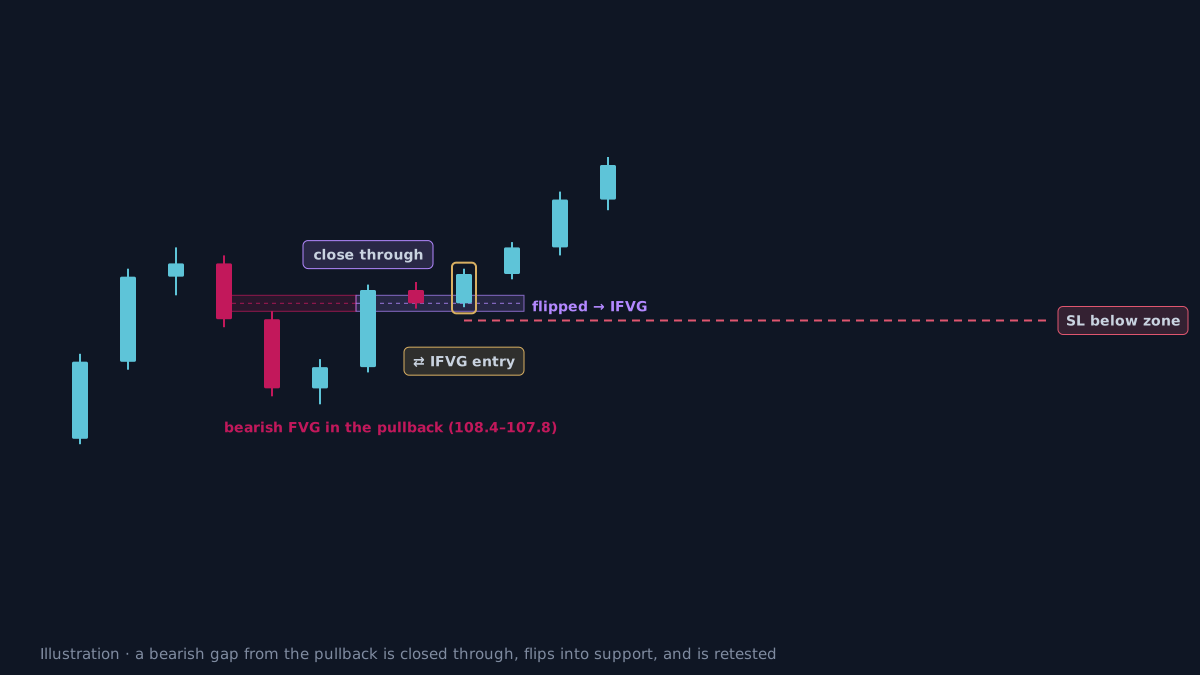 Illustration, not real market data. The red zone is the pullback’s bearish FVG; the purple zone is after the flip.
How does AURORA Pro identify SMC IFVG?
- Stage 1, record the zone: during an up (down) trend cycle, an opposite-direction FVG of 0.2 ATR or more forms.
- Stage 2, the flip: within at most 30 bars, price closes beyond the far side of the zone. The zone turns purple on the chart.
- Stage 3, the retest: within at most 15 bars of the flip, price touches the zone and a with-trend candle closes beyond its midpoint. Label
⇄ SMC IFVG, with a Q score. - Invalidation: price closes back through the other side, the time limit runs out, or the trend cycle flips. The zone turns grey.
- Structural stop: 0.1 ATR beyond the zone edge, at least 0.3 ATR from the entry; a
⚠SLlabel when wider than 4 ATR. - Shared SMC conditions:
- Trend-cycle direction only.
- By default, price on the right side of the Trailing line.
- The Entry Filter Profile minimum score applies.
- On the same candle, BREAK / SUNNY win; within SMC, IFVG ranks after SWEEP and RETEST.
- Separate statistics in the
↳ ⇄ IFVGdashboard sub-row (Full layout).
Limits of IFVG
- Zones are often thin. A pullback FVG can be very small, pushing the stop out to the 0.3 ATR minimum.
- Rare. It needs three consecutive stages within time limits, so it is rarer than RETEST.
- Ranging markets create many small two-way FVGs and false flips.
- Validate it separately. Compare the IFVG row with RETEST and SWEEP across symbols before trusting the setup. Historical results, before costs.
Practical checklist
- Only consider opposite-direction FVGs formed in a pullback of the main trend.
- An FVG flips only when a candle closes through the whole zone.
- Wait for price to return to the zone and a with-trend candle to close beyond the midpoint.
- Drop the setup if price closes back through the other side, or the wait runs too long.
- Place the stop beyond the zone; with thin zones, remember the minimum stop distance.
Video Explainer
The video for this article is in production. The full written lesson is already complete.
Video chapters
- Resistance turns into support
- An FVG in the pullback
- The flip and the retest
- The rules in AURORA Pro
- Limits
Show transcript
Product documentation
Educational and decision-support content, not investment advice. Chart examples are illustrative or historical and do not guarantee future results. Trading carries a risk of capital loss.