The question
Two SMC setups are both valid: which one has more room to run before it meets the first obstacle?
After this lesson you will
- Know the four SMC Quality components
- Understand room to the opposing liquidity measured in R
- Know how to validate SMC Quality before using Filter mode
What is SMC Quality?
For BREAK and SUNNY setups, AURORA Pro computes Setup Quality. For SMC setups, the equivalent is SMC Quality, on a 0–100 scale, built from four components:
| Component | What it measures |
|---|---|
| Displacement | How large the confirmation candle’s body is relative to ATR, and its relative volume |
| Zone / sweep quality | RETEST, IFVG: how fresh the zone is and whether its size is sensible. SWEEP: how deep the sweep was and how strongly price reclaimed |
| Room to liquidity | How many R away the nearest unbroken swing ahead sits |
| Path efficiency | Whether the recent price path is clean or noisy |
Why does room to liquidity matter?
- Targets need somewhere to go. If the opposing liquidity, the nearest unbroken high for a long trade, is only half an R away, price may react before TP1.
- Measured in R, not price points. The same 10-point distance is many R with a tight stop and few R with a wide stop.
- It interacts with the structural stop. A wide stop shrinks the room in R; the Q score reflects that.
Common misunderstandings
- High Q means a sure win. No. It is a descriptive score; its value must be proven with statistics.
- SMC Quality and Setup Quality are comparable. The two scales measure different things; compare only within the same setup type.
- The three SMC setups are scored the same way. The “zone quality” component measures zones for RETEST / IFVG and the sweep for SWEEP.
Chart example
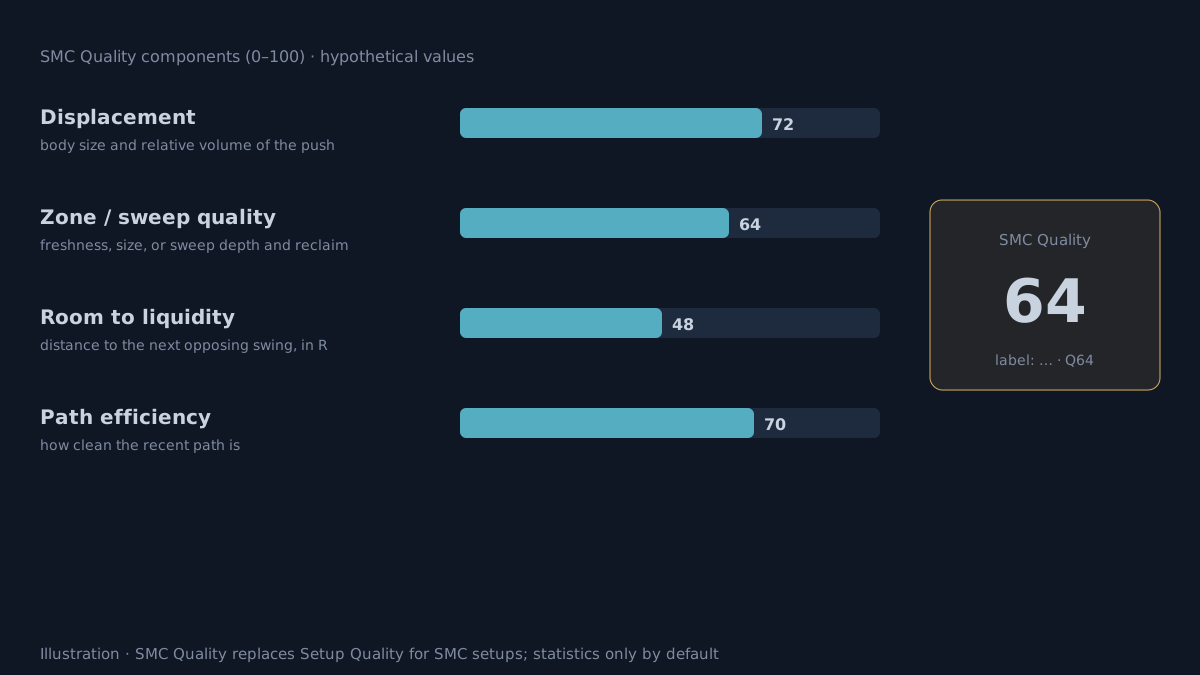 Illustration with hypothetical values.
How does AURORA Pro display SMC Quality?
- On the label: for example
💧 SMC SWEEP · BUY · 66 · Q64, plus⚠SLwhen the stop is wide. - Tooltip: an
SMC Q 64line. - JSON alerts: the
setup_qualityfield carries SMC Quality for SMC setups. - Strategy Validator: trade names, for example
SMC-RETEST-L Q64. - Two modes (the SMC Quality mode box):
- Stats only (default): scores, never blocks.
- Filter (experimental): blocks setups below the threshold, 60 by default; a
⛔ SMClabel shows the reason “SMC Quality < 60”.
- The dashboard reports statistics by setup type (RETEST, SWEEP, IFVG). Q-bucket analysis is done on the Validator’s trade list.
Validate before filtering
- Split by setup type. RETEST, SWEEP and IFVG can respond very differently to the same Q score.
- Average R should rise from low to high Q buckets, repeating across symbols.
- Enough trades. SMC setups are rarer than BREAK; it takes time to build a sample.
- Check out-of-sample before switching on Filter. Historical results, before costs.
Practical checklist
- Read the Q score on the SMC label together with any ⚠SL warning.
- Check the room to the first obstacle: below 1R, even TP1 is hard.
- Keep Stats only mode until you have enough SMC trades.
- Analyse by Q bucket on the Validator's trade list.
- Analyse RETEST, SWEEP and IFVG separately; each behaves differently.
Video Explainer
The video for this article is in production. The full written lesson is already complete.
Video chapters
- How much room is left
- Four components
- Room to liquidity
- Display in AURORA Pro
- Validate before filtering
Show transcript
Two SMC setups are both valid. One has its first obstacle 3R away, the other only half an R away. The second will struggle to reach even TP1.
SMC Quality combines four things: the strength of the push, the quality of the zone or sweep, the room to the opposing liquidity measured in R, and how clean the recent price path is.
The score appears right on the SMC label, for example Q64, and is recorded in the JSON alert and in Strategy Validator trade names.
By default SMC Quality is statistics only. Switch on filtering only when high-score groups clearly perform better across many symbols.
Product documentation
Educational and decision-support content, not investment advice. Chart examples are illustrative or historical and do not guarantee future results. Trading carries a risk of capital loss.